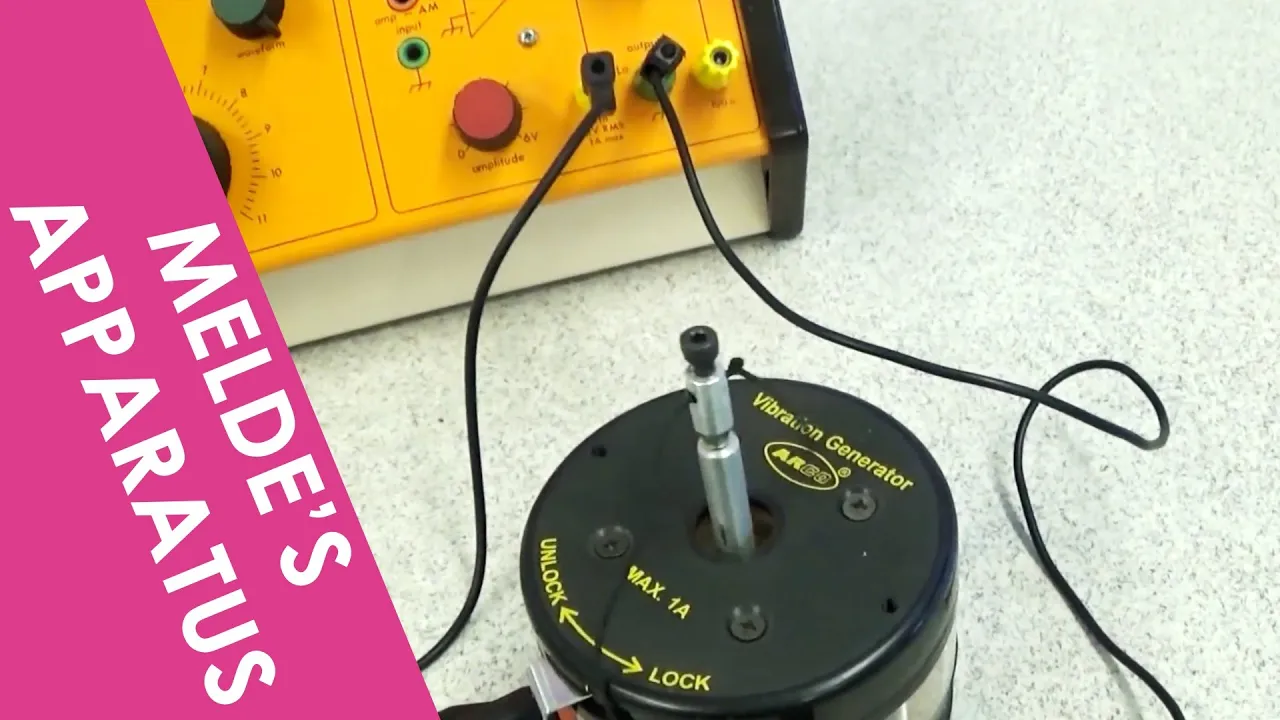
This video explains standing waves on a string as well as using Melde’s Apparatus to perform a practical demonstration for A Level Physics.
We can connect a string to a hanging mass at one end and an oscillating pole that is connected to a signal generator at the other. This means that the string is effectively fixed at both ends. Increasing the frequency of oscillations can produce standing waves on the string. The parts of the string that don’t appear to move are called the nodes and the parts that have maximum displacement are called the antinodes.
Thanks for watching,
Lewis
This video is recommended for anyone studying A Level Physics in the following exam boards: AQA CIE Edexcel Edexcel IAL Eduqas IB OCR A OCR B WJEC
MY PHYSICS WEBSITES Find even more videos organised by exam board and topic at:
   GCSE Physics Online
   ► https://www.gcsephysicsonline.com
   A Level Physics Online
   ► https://www.alevelphysicsonline.com
MY YOUTUBE CHANNEL Your support in watching this video has been invaluable! To contribute towards the free videos on YouTube, make a small donation at: ► https://www.paypal.me/physicsonline
FOLLOW ME ► https://www.youtube.com/physicsonline?sub_confirmation=1 ► https://www.instagram.com/physicsonline/ ► https://www.facebook.com/gcseandalevelphysicsonline
#waves #alevelphysics #physicsonline